
UPAC paperwork in Portugal: a short checklist: The minimum paperwork chain for small self-consumption units.
Small grid-connected self-consumption units in Portugal follow a notification-based path, but the sequence matters. Submitting steps out of order is the most common cause of stalled projects.
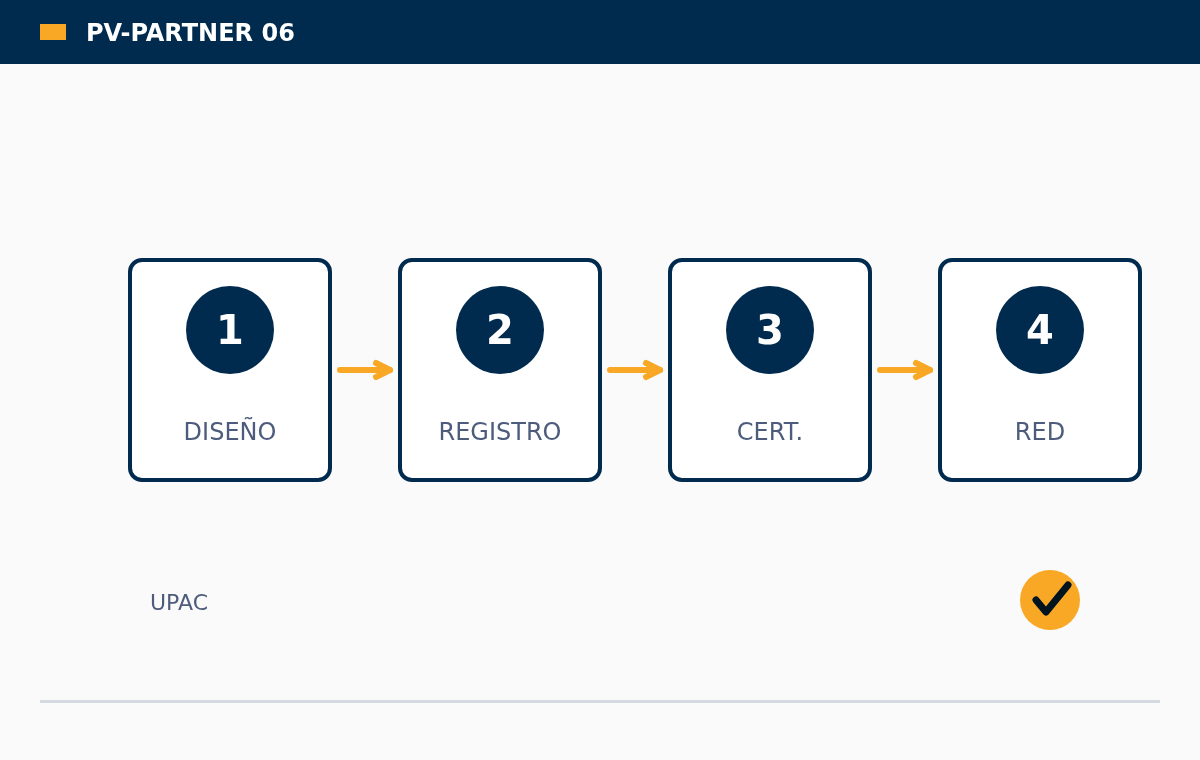
Checklist skeleton
- Confirm the network operator and the connection arrangement before design freeze.
- File the registration with the correct self-consumption unit identifier.
- Keep the inverter certification documents ready for the operator's request.
Build the checklist into your project template so every new UPAC follows the same order. Consistency is what keeps small projects moving.
1. Capacity-Dependent Registration Tiers under Portugal's Decreto-Lei n.º 15/2022 & DGEG
In Portugal, the licensing procedure for Self-Consumption Production Units (Unidades de Produção para Autoconsumo — UPAC) is strictly determined by the total installed AC inverter power (in kW). According to Decreto-Lei n.º 15/2022, simplified by Decreto-Lei n.º 30-A/2022, and enforced through the DGEG Electronic Portal, installers must follow one of four statutory tracks:
- Tier 1 — Up to 700 W (≤ 0.7 kW): Exempt from Prior Control (Isento de Controlo Prévio) when the system is not intended to inject surplus power into the public grid (or while national aggregate capacity remains below the statutory threshold). Equipment must still carry EN 50549-1 certification.
- Tier 2 — Above 700 W up to 30 kW (> 0.7 kW to ≤ 30 kW): Mera Comunicação Prévia (MCP) submitted online via the DGEG portal. Once the submission receipt (comprovativo de apresentação) is issued, the installation can enter operation immediately without waiting for prior DGEG inspection.
- Tier 3 — Above 30 kW up to 1 MW (> 30 kW to ≤ 1,000 kW): Requires Registo Prévio followed by an inspection report and the issuance of the Certificado de Exploração before grid energisation. Systems > 30 kW also require prior connection conditions from E-REDES and bidirectional telemetering.
- Tier 4 — Above 1 MW (> 1,000 kW): Subject to full Licença de Produção and Licença de Exploração procedures, including grid capacity reservation and protection relay testing.
2. Mandatory Technical Documentation for DGEG & E-REDES Submissions
Before freezing the electrical design, compile the CPE (Código de Ponto de Entrega) from the latest electricity bill, single-line diagram (esquema unifilar) compliant with RTIEBT rules, the signed Termo de Responsabilidade of the DGEG-accredited responsible technician or installation company, and official CE / EN 50549-1 conformity certificates for every inverter model.
| Installed Capacity Tier (DL 15/2022 & DL 30-A/2022) | DGEG Licensing Procedure | Grid Injection, Metering & Certification Rules |
|---|---|---|
| Up to 700 W (<= 0.7 kW) | Exempt from Prior Control (Isento de Controlo Prévio) | Allowed if not injecting to RESP (or until national 1 MVA quota); EN 50549-1 compliant microinverter/inverter |
| Above 700 W up to 30 kW (> 0.7 kW to <= 30 kW) | Mera Comunicação Prévia (MCP) on DGEG Portal | Immediate commissioning upon DGEG receipt; requires qualified technician term of responsibility & DGEG-listed inverter |
| Above 30 kW up to 1 MW (> 30 kW to <= 1,000 kW) | Registo Prévio + Certificado de Exploração (DGEG / E-REDES) | E-REDES grid capacity validation, bidirectional telemetering (GPRS/IP), and inspection before final operation certificate |
| Above 1 MW (> 1,000 kW) | Licença de Produção + Licença de Exploração | Full DGEG/E-REDES grid impact study, environmental clearance where applicable, and substation protection relay testing |
B2B Technical Documentation & Pallet Dispatch Desk
Access official manufacturer datasheets, EU grid certificates, and full-pallet trade pricing across Spain and Portugal.
Frequently Asked Questions (FAQ)
What is the difference between Mera Comunicação Prévia (MCP) and Registo Prévio for UPAC in Portugal?+
Under Decreto-Lei n.º 15/2022 and DL 30-A/2022, UPAC installations > 700 W up to 30 kW follow Mera Comunicação Prévia (MCP) on the DGEG portal and can operate immediately upon submission receipt. Installations > 30 kW up to 1 MW require Registo Prévio, E-REDES connection conditions, inspection, and a Certificado de Exploração.
When is a small solar installation exempt from DGEG prior control in Portugal?+
UPAC systems with an installed AC power of 700 W or less (<= 0.7 kW) that do not inject surplus power into the public grid (RESP) are exempt from prior DGEG registration.
Where can installers download inverter certificates for DGEG and E-REDES submissions?+
All inverters distributed by PV-PARTNER include official EN 50549-1 and EU conformity certificates on their product pages, ready for DGEG portal upload.
Author: Virginie Paulo (Senior PV Distribution & Regulatory Specialist) · Technical review: Hendryk Knuth (Technical Director, PV-PARTNER / YOFI SUN S.L.) · Regulatory & technical verification date: 4 November 2026. Prepared with AI-assisted drafting and verified against primary BOE, DGEG, and manufacturer documentation.