
Victron Energy Battery Compatibility Guide: BMS-Can, Tested Lithium Brands and DVCC Commissioning: Selecting an officially tested 48V LiFePO4 battery with closed-loop BMS-Can communication on a Victron Cerbo GX prevents false overload alarms, cell overvoltage trips, and unscheduled site callouts.
Pairing third-party lithium batteries with Victron Energy inverter/chargers (MultiPlus-II 48/5000 GX, Quattro, RS) and SmartSolar MPPT charge controllers is one of the most reliable architectures for off-grid, backup, and commercial ESS projects in Spain and Portugal. However, while lead-acid chemistries (AGM, Gel, OPzS, OPzV) rely on fixed absorption and float voltage curves, lithium iron phosphate (LiFePO4) packs require real-time digital coordination between the Battery Management System (BMS) and the power electronics.
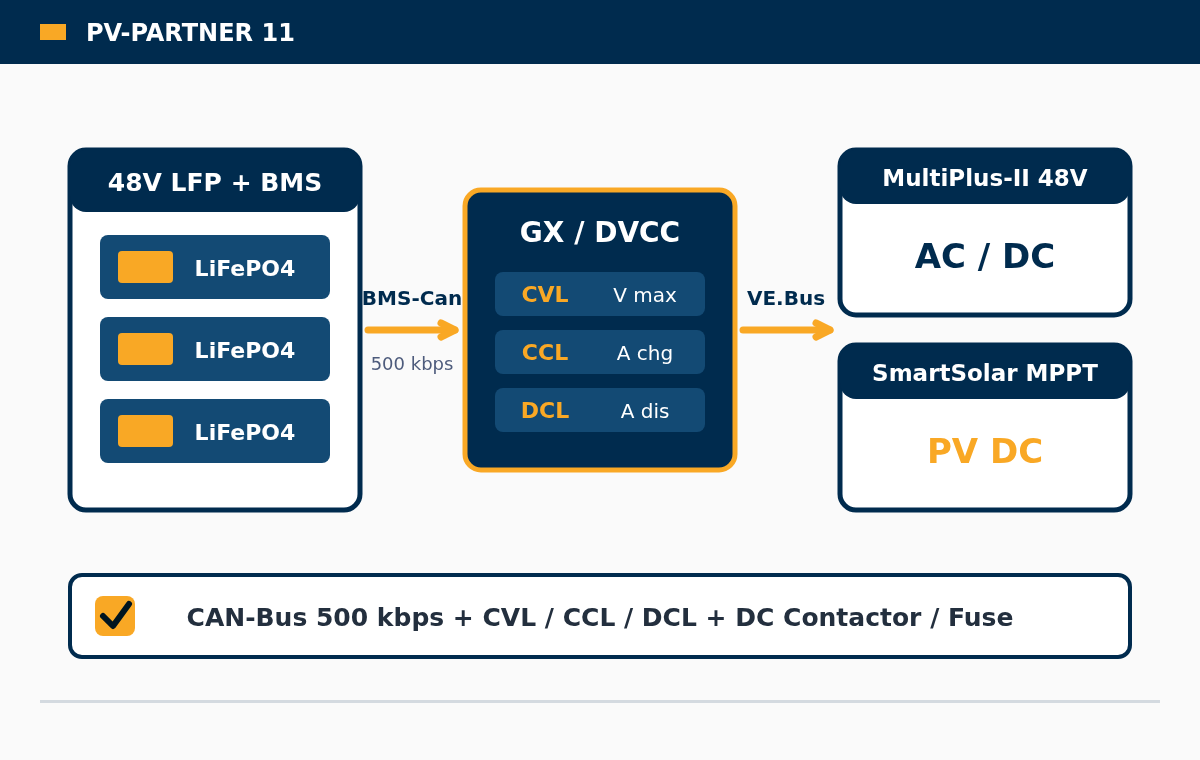
1. How Closed-Loop BMS-Can & DVCC Control Work
As documented in the official Victron Energy Battery Compatibility manual, managed lithium batteries connect to a GX device (Cerbo GX MK2 or Cerbo-S GX) via the BMS-Can (500 kbps CAN-bus) port using the specific VE.Can to CAN-bus BMS cable Type A or Type B. Once detected, Venus OS enables DVCC (Distributed Voltage and Current Control) and broadcasts three dynamic limits across all connected inverters and MPPT solar chargers:
- CVL (Charge Voltage Limit, in V): The primary control parameter. When the battery approaches 100% State of Charge (SoC) or a cell reaches high-voltage threshold, the BMS must dynamically lower CVL to taper charging power smoothly.
- CCL (Charge Current Limit, in A): Caps total DC charge current from both the AC charger and solar MPPTs based on cell temperature and SoC.
- DCL (Discharge Current Limit, in A): Protects the pack at low SoC or low temperature by restricting inverter draw before the internal BMS contactor opens.
2. Officially Tested Third-Party Lithium Batteries vs. DIY BMS Pitfalls
Victron maintains a verified compatibility list of manufactured battery packs with integrated BMS—including Dyness, Pylontech, BYD B-Box, Cegasa eBick, Pytes, Freedom Won, BMZ, BSLBATT, Sunwoda, WeCo, and ZYC Energy, alongside native Victron Lithium & AGM/Gel batteries. Using unlisted or custom DIY/self-build BMS units (outside known compliant controllers such as REC BMS, Batrium, 123\SmartBMS, or Boostech) frequently causes two field failures:
- False Overload Alarms under Light Load: If a custom BMS abruptly blocks discharge current or drops CCL/DCL to
0 Awhen full, the MultiPlus-II can report a misleading Overload alarm even with minimal AC load—wasting hours of installer troubleshooting. - Overvoltage & Overcharge Warnings at 100% SoC: If a BMS tries to throttle end-of-charge power by setting
CCL = 0 Awithout lowering the Charge Voltage Limit (CVL), solar MPPTs trying to feed AC loads can spike DC bus voltage and trigger overvoltage trips.
3. Non-Negotiable DC Safety: Intrinsic Chemistry & Physical Contactors
Digital CAN-bus signals (CCL = 0 A) are a control layer, never a primary safety disconnect. Every lithium battery bank must use intrinsically safe cells (LiFePO4) and incorporate its own heavy-duty physical disconnect mechanism (contactor or motorized circuit breaker) plus properly rated DC fusing such as the Victron Lynx Class-T Power In and Lynx Distributor.
| Battery / BMS Category | Official Victron Protocol & Hardware | Installer Commissioning Rule |
|---|---|---|
| Tested 48V LFP Brands (Dyness, Pylontech, BYD, Cegasa, Pytes) | Closed-loop BMS-Can (500 kbps) on Cerbo GX + VE.Can Cable Type A/B + 120 Ω terminator | Enable DVCC; verify BMS controls CVL, CCL and DCL in Venus OS |
| Victron Lead-Acid (AGM, Gel, OPzS, OPzV) | 2-wire DC + temperature sensor on MultiPlus-II / SmartSolar MPPT | Select exact absorption/float preset via VEConfigure or VictronConnect |
| 3rd-Party DIY BMS (REC, Batrium, 123\SmartBMS, Boostech) | Follows Victron CAN specification (not factory-tested by Victron; limited support) | Ensure BMS regulates end-of-charge via CVL (never drop CCL to 0 A alone) |
| Mandatory DC Protection | Intrinsic LiFePO4 cells + physical main contactor + Lynx Class-T / CNN fuse | Never rely solely on digital CAN signals to interrupt overcharge |
Source Compatible Equipment by Category
Direct B2B access to Tier-1 stock, technical datasheets, and pallet quantities:
Need a Custom B2B Quote, Pallet Pricing, or Engineering BOM Review?
Our Iberian PV distribution engineers support installers and EPCs across Spain and Portugal with string sizing, inverter-battery compatibility checks, and scheduled site deliveries.
Frequently Asked Questions (FAQ)
Which lithium batteries are officially tested as compatible with Victron Energy?+
Victron's tested compatibility list includes Dyness, Pylontech, BYD B-Box, Cegasa eBick, Pytes, BMZ, BSLBATT, Freedom Won, Sunwoda, WeCo, ZYC Energy, and native Victron Lithium batteries connected via BMS-Can on a GX device.
Why does a Victron MultiPlus-II show false overload or overvoltage alarms with some lithium batteries?+
If an unverified or DIY BMS blocks current abruptly or sets Charge Current Limit (CCL) to 0 A when full instead of lowering the Charge Voltage Limit (CVL), the inverter/charger can trigger false overload or DC overvoltage warnings.
Which communication cable and port are needed between a 48V lithium battery and a Cerbo GX?+
Connect the battery's CAN port to the BMS-Can (500 kbps) port on the Cerbo GX using the official Victron VE.Can to CAN-bus BMS cable (Type A or Type B depending on battery pinout) and install the 120-ohm bus terminators.
Where can installers in Spain and Portugal order matched Victron + Dyness bundles?+
Open a B2B installer account on PV-PARTNER or contact our engineering desk via the Contact page for verified Victron MultiPlus-II, Cerbo GX, SmartSolar MPPT, and Dyness LiFePO4 pallet quotes.
Author: Virginie Paulo (Senior PV Distribution & Regulatory Specialist) · Technical review: Hendryk Knuth (Technical Director, PV-PARTNER / YOFI SUN S.L.) · Regulatory & technical verification date: 4 November 2026. Prepared with AI-assisted drafting and verified against primary BOE, DGEG, and manufacturer documentation.