
Global Solar Module Roadmap 2026–2027: N-Type TOPCon (85% Share), Back Contact (BC) & the New 23.2% Mandatory Efficiency Floor: Mono PERC has dropped below 5% of global output while N-Type TOPCon reaches 24.5% efficiency, Back Contact (BC) expands on premium roofs, and strict 2027 efficiency standards reshape B2B procurement.
Legacy p-type PERC modules are officially history: Global production data from CRU and discussions at the PV ModuleTech Europe 2026 summit in Málaga confirm that N-Type TOPCon now accounts for nearly 85% of global solar module manufacturing, while mono PERC has fallen below 5%. At the same time, Back Contact (BC) architectures are scaling rapidly for high-density rooftops, and a new mandatory Chinese national PV standard taking effect on 1 January 2027 will bar manufacturing of TOPCon and HJT modules below a 23.2% conversion efficiency floor.
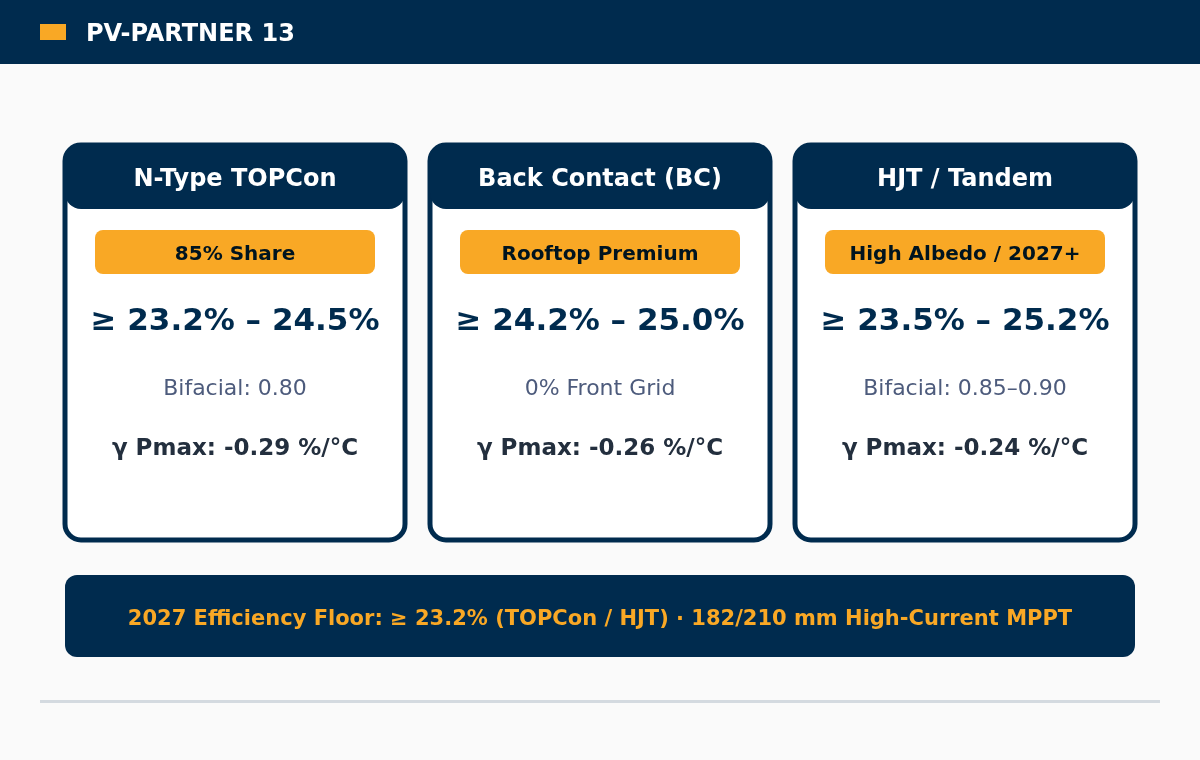
1. N-Type TOPCon 3.0 vs. Back Contact (BC) vs. HJT: Where Each Technology Wins
Leading Tier-1 manufacturers (JinkoSolar, Trina Solar, LONGi, JA Solar, Canadian Solar) have split the 2026–2027 module roadmap into two clear application tracks:
- Bifacial N-Type TOPCon (510 Wp to 720 Wp): The undisputed workhorse for commercial & industrial (C&I) flat roofs, carports, and utility plants. With front-side efficiency reaching 23.2% to 24.5%, a superior temperature coefficient (-0.29 %/°C vs. -0.35 %/°C on PERC), and an 80% bifaciality factor, dual-glass TOPCon delivers the lowest EUR/Wp and lowest LCOE.
- Back Contact (BC / ABC / HPBC): By moving all metal gridlines and solder ribbons to the rear of the cell, BC modules eliminate front optical shading and push conversion efficiency to 24.2%–25.0% with a uniform estética-black appearance. However, as engineering auditors noted at PV ModuleTech Europe in Málaga, BC involves more complex manufacturing steps and trades at a price premium (~0.118 EUR/Wp vs. ~0.107 EUR/Wp for TOPCon), making it primarily a space-constrained residential rooftop product.
- Heterojunction (HJT) & Perovskite Tandem R&D: HJT leads in ultra-high bifaciality (85%–90%) and hot-climate temperature coefficient (-0.24 %/°C to -0.26 %/°C), while laboratory perovskite-silicon tandems reached 32.6% (886 W on 3.1 m²) in 2026 ahead of post-2028 commercialization.
2. The 1 January 2027 Mandatory Efficiency Standard (23.2% Floor)
Jointly issued by China's MIIT, NDRC, and SAMR for implementation on 1 January 2027, the new national PV industry standard enforces strict Grade 3 minimum module conversion efficiencies — setting the mandatory entry floor at 23.2% for N-Type TOPCon and HJT modules. Sub-threshold production lines are being retired, accelerating the global shift toward high-wattage 182 mm and 210 mm rectangular wafer formats (580 Wp, 635 Wp, 710–720 Wp).
3. Electrical Design Impact for Iberian Installers: High-Current MPPT Matching
Modern 580 Wp to 720 Wp N-Type modules operate at maximum power currents (Imp) between 13.5 A and 17.6 A (and short-circuit currents Isc exceeding 18.5 A before bifacial gain). Installers must pair them with inverters featuring 16 A to 20 A per string input (32 A to 40 A per MPPT tracker) — such as the Huawei SUN2000-LC0/MAP0/KTL series, Deye SG04/05, Solis C&I, and Fox ESS G3/P3 stocked by PV-PARTNER.
| Cell Architecture (2026–2027) | Module Efficiency & Thermal Coeff. | Bifaciality & Best Iberian Application |
|---|---|---|
| N-Type TOPCon (3rd Gen / 85% global share) | 23.2% to 24.5% · γ Pmax: -0.29 %/°C | 80% bifacial factor — #1 ROI for C&I flat roofs, industrial sheds & standard residential (Jinko Tiger Neo / Trina Vertex) |
| Back Contact (BC / HPBC / ABC) | 24.2% to 25.0% · γ Pmax: -0.26 %/°C | 0% front metal shading — best for space-constrained residential roofs & strict architectural aesthetics |
| Heterojunction (HJT) | 23.5% to 24.8% · γ Pmax: -0.24 %/°C | 85%–90% bifacial factor — specialized high-albedo ground mounts, carports & extreme summer heat |
| 1 Jan 2027 Mandatory Standard | >= 23.2% minimum efficiency floor (TOPCon/HJT) | Retires legacy sub-23% modules; requires inverters with >= 16 A–20 A per string MPPT input |
Source Matching Tier-1 Equipment in the PV-PARTNER B2B Shop
Direct trade access to verified product categories, official EU datasheets, and pallet stock across Spain and Portugal.
Frequently Asked Technical Questions (FAQ)
What share of global solar module production does N-Type TOPCon hold in 2026?+
According to CRU market data, N-Type TOPCon accounts for nearly 85% of global solar module production in 2026, while legacy p-type mono PERC has dropped below 5%.
What is the new mandatory solar module efficiency standard taking effect on 1 January 2027?+
Starting 1 January 2027, China's mandatory national PV standard requires a minimum module conversion efficiency of 23.2% for N-Type TOPCon and HJT modules, phasing out older lower-efficiency lines.
When should an installer choose N-Type TOPCon over Back Contact (BC) modules?+
N-Type TOPCon dual-glass modules offer the best EUR/Wp ratio and 80% bifacial gain for commercial roofs, industrial sheds, and standard residential roofs, whereas Back Contact (BC) modules are suited for small residential roofs where maximum Wp per square meter justifies a ~10% module price premium.
Which high-efficiency N-Type modules are available by the pallet at PV-PARTNER?+
PV-PARTNER stocks Jinko Tiger Neo N-Type (510 Wp, 585–590 Wp, 635 Wp, and 720 Wp BDV bifacial) and Trina Solar Vertex S+ N-Type modules with full EU datasheets and pallet logistics across Spain and Portugal.
Author: Virginie Paulo (Senior PV Distribution & Regulatory Specialist) · Technical review: Hendryk Knuth (Technical Director, PV-PARTNER / YOFI SUN S.L.) · Regulatory & market verification date: 19 November 2026. Prepared with AI-assisted drafting and verified against Montel Q2/Q3 2026, Wood Mackenzie, LevelTen Energy, and manufacturer documentation.