
Industrial BESS After the Iberian Blackout: Full-System Certification, Insurer Audits & Grid-Forming Inverters: Cell-only certificates are no longer enough for C&I insurers or grid legalization: how to verify full-system IEC 62619 / UL 9540A compliance, grid-forming black-start capability, and real-time zero-export control.
Buying a commercial battery solely on EUR/kWh can leave an industrial facility uninsured and unlegalized: Since the historic Iberian grid blackout of 28 April 2025, demand for commercial and industrial (C&I) battery energy storage systems (BESS) across Spain and Portugal has surged. However, as technical engineering audits published in pv magazine España in November 2026 warn, many low-cost battery cabinets marketed today only hold certificates for the individual LFP cell — while the complete integrated system (racks, BMS, HVAC/fire suppression, and PCS) has never been tested as an assembly.
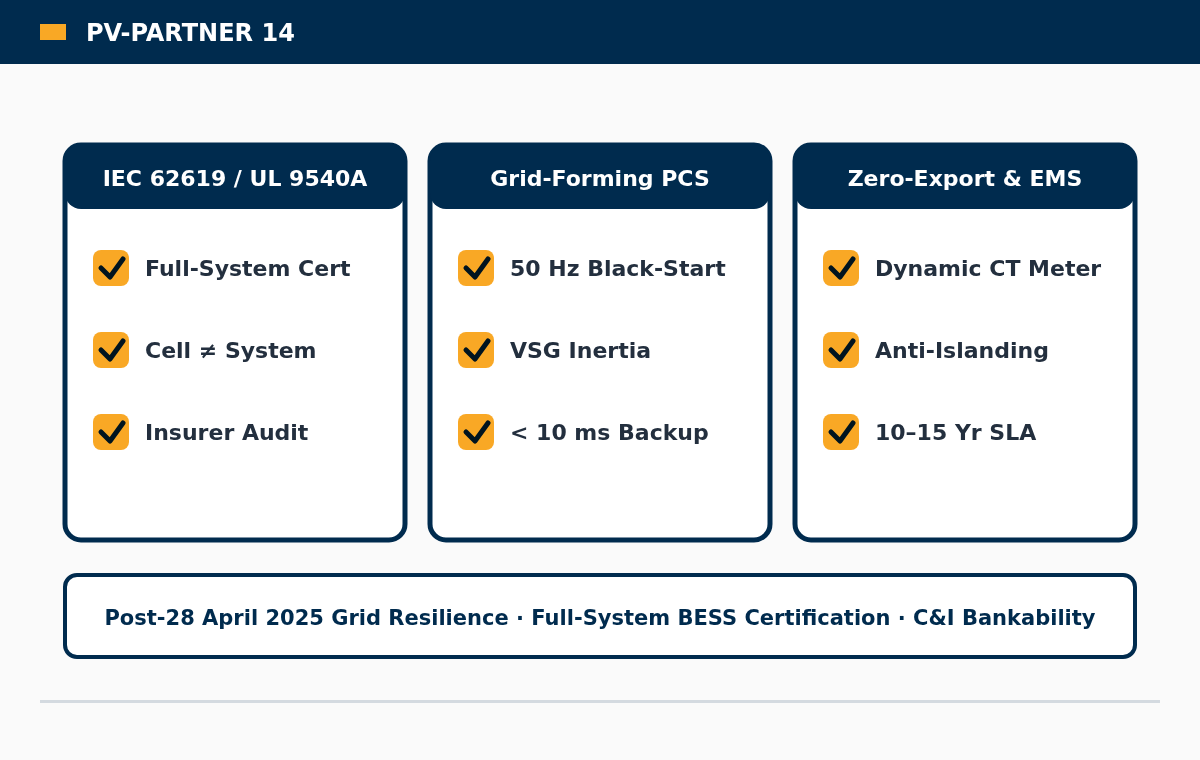
1. Cell Certificate vs. Full-System Certification: What Industrial Insurers Inspect
When an industrial factory adds a 100 kWh to 500 kWh BESS next to its production warehouse, property insurers and municipal licensing engineers now audit three mandatory layers:
- Complete System Safety (IEC 62619, IEC 63056 & UL 9540A thermal runaway propagation): A cell-level UN 38.3 or cell-only IEC 62619 sheet does not prove that the BMS contactor, fuse coordination, and cabinet ventilation will contain a cell fault. Insurers increasingly require full-system test reports and integrated aerosol/gas fire suppression (as built into Dyness BF100/DH200F C&I cabinets, Huawei LUNA2000, and Fox ESS systems).
- 10-to-15-Year Supplier Bankability & European Spare Parts: Meanwhile, recent global market shakeouts — such as SolarEdge closing its local commercial operations in Australia in November 2026 to refocus on infrastructure — remind installers why choosing Tier-1 manufacturers with established European distribution and local RMA stock is critical over a 15-year BESS lifecycle.
2. Grid-Forming Capabilities & Black-Start Resilience
Following the April 2025 grid outage, industrial clients no longer want a battery that shuts down the moment the public grid fails. Modern grid-forming inverters and PCS units create their own stable 50 Hz voltage and frequency reference (Virtual Synchronous Generator — VSG mode), absorb factory motor inrush currents, and transition to islanded backup in under 10–20 ms (for example, Huawei SUN2000-MAP0 with SmartGuard, Deye three-phase LV/HV hybrids, and Victron MultiPlus-II / Quattro).
3. Dynamic Zero-Export & Grid-Limit Coordination
Most industrial self-consumption plants in Spain (RD 244/2019) and Portugal (UPAC DL 15/2022) are legalized with strict export caps or zero-export permits. Adding a battery requires real-time closed-loop coordination between the PV array, battery PCS, factory load, and directional smart meter so the battery never accidentally exports power above the authorized threshold and invalidates the plant's operating license.
| BESS Audit Layer | What Fails Insurer / Grid Inspection | 2026–2027 Bankable Engineering Standard |
|---|---|---|
| Safety & Fire Certification | Cell-only UN 38.3 / IEC 62619 sheet without cabinet-level assembly test | Full-system IEC 62619, IEC 63056, UL 9540A thermal propagation + integrated aerosol/gas fire suppression |
| Grid Outage & Backup Mode | Grid-following inverter that trips offline during blackouts (like 28 Apr 2025) | Grid-Forming PCS with 50 Hz black-start, < 10–20 ms transfer & 100%–150% asymmetric phase support |
| Export Limit & Legalization | Uncoordinated battery discharge breaching zero-export or DSO permit cap | Closed-loop EMS + directional CT meter + Spain NTS 631 / UNE 217002 & Portugal DGEG / EN 50549-1 certs |
| 15-Year Lifecycle Support | Grey-market import without local RMA or matched PCS-BMS firmware support | Pre-validated PV-PARTNER C&I & commercial kits (Dyness BF100/DH200F, Huawei LUNA2000, Fox ESS, Deye, Victron) |
Source Matching Tier-1 Equipment in the PV-PARTNER B2B Shop
Direct trade access to verified product categories, official EU datasheets, and pallet stock across Spain and Portugal.
Frequently Asked Technical Questions (FAQ)
Why do industrial insurers reject battery systems that only have cell-level certificates?+
A cell-level certificate does not validate the complete cabinet assembly, BMS contactor coordination, ventilation, or thermal runaway containment. Insurers require system-level IEC 62619 / IEC 63056 and UL 9540A testing plus integrated fire suppression.
What is a grid-forming inverter and why did demand surge after the 28 April 2025 Iberian blackout?+
Unlike standard grid-following inverters that shut down when the utility grid disappears, a grid-forming inverter generates its own stable 50 Hz voltage and frequency reference, enabling black-start and uninterrupted factory or home backup.
How does adding a battery affect an industrial zero-export self-consumption license?+
The Energy Management System (EMS) must coordinate PV generation, battery discharge, and facility load in real time via a directional meter so the battery never exports power into the public grid in violation of the plant's legalization permit.
Which C&I and commercial battery storage systems does PV-PARTNER supply in Spain and Portugal?+
PV-PARTNER distributes full-system certified commercial and industrial BESS solutions including Dyness BF100-C100 (100 kW / 107.5 kWh), Dyness DH200F (200 kW / 261 kWh), Dyness Stack100, Huawei LUNA2000, and Fox ESS paired with Deye, Huawei, and Victron inverters.
Author: Virginie Paulo (Senior PV Distribution & Regulatory Specialist) · Technical review: Hendryk Knuth (Technical Director, PV-PARTNER / YOFI SUN S.L.) · Regulatory & market verification date: 19 November 2026. Prepared with AI-assisted drafting and verified against Montel Q2/Q3 2026, Wood Mackenzie, LevelTen Energy, and manufacturer documentation.